'/%3E%3Cpath%20fill='%23b2b2b2'%20d='M241%20382q0%2016%2017%2026%2017%2011%2042%2011t42-11q16-11%2017-26V269H241'/%3E%3Cpath%20fill='%239f7e00'%20d='M241%20379q0%2014%208%2023%209%209%2021%209%2014%200%2021-9%209-9%209-23V269h-59'/%3E%3Cpath%20d='M241%20339v-70h59v110q0%2014-9%2023l-6%205v-68h-15v72q-8%200-14-4v-68zm59%2040c0%2022%2015%2032%2029%2032%2021%200%2030-18%2030-32v-40h-59'/%3E%3Cpath%20fill='%239f7e00'%20d='M266%20277v5h2v12h-3v-5h2v-5h-9v5h2v5h-4v9h3v18h-5v10h34v-10h-5v-18h3v-9h-4v-5h2v-5h-9v5h2v5h-3v-12h2v-5zm42%20101q0%2010%206%2017%206%206%2015%207%2010-1%2016-7%206-7%206-17v-29h-43'/%3E%3Ccircle%20fill='%230044ad'%20cx='329.5'%20cy='372'%20r='6'/%3E%3Cellipse%20fill='%230044ad'%20cx='300'%20cy='340'%20rx='16'%20ry='21'/%3E%3C/svg%3E)








The Spanish Women’s National Team has experienced a very important 2024 full of ups and downs. After winning the World Cup in Australia and New Zealand in the summer of 2023, the future of Spain seemed destined for much more success. And so it was later with the winning of the Nations League. However, the shock at the Olympic Games was a turning point.

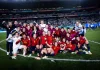
Winning the World Cup represented a historic milestone for women’s football in Spain. It also provided food for thought after a year marked by controversy and tensions within the Spanish national team with ‘The 15’ and later, the Rubiales affair and the sacking of Jorge Vilda. However, the good football of the Spaniards managed to cover up some of the extra-sporting issues.
2024 looked set to be a big year for the team, now coached by Montse Tomé. At the Nations League, held at La Cartuja in Seville, Spain showed their best side by defeating top teams such as the Netherlands and France. The image of Alexia Putellas, Jenni Hermoso and Irene Paredes as leaders of the team cemented confidence and was the very essence that the journey and the fight had been worth it.

This triumph gave Spain direct access to the Olympic Games, a stage where the players were expected to accumulate more success on the international stage in their historic first appearance. Despite the return of Patri Guijarro and strong performances from Aitana Bonmatí and Alexia Putellas, the Spanish team failed to perform at the expected level.
Spain lost to Brazil in the semi-finals and to Germany in the bronze final, leaving Spain with no chance of a medal. In the aftermath, questions were raised about the team’s direction and Montse Tomé’s ability as coach. A lack of defensive strength and a lack of fluidity in play led to questions about whether the team was in crisis.
The draws against Canada and Italy did not help to dispel the doubts, which showed that Spain had to change a few things to recover their best version and return to being the team feared by their rivals months ago. Montse Tomé’s last call-up of the year generated new debates. The decision to leave out some players considered pillars of the dressing room, such as Misa Rodríguez, Irene Paredes and Jenni Hermoso, did not go unnoticed and increased the pressure on Spain.

The positive note was the call-up of Claudia Pina, who had been knocking on the door of a return to the national team for months after her great games for Barça. Her performance in the last few games with the ’10’ on her back was relevant, scoring two goals in two games, giving a blow on the table to return to be fixed with Spain.
The debut of Maca Portales came during this break, who presented herself as a real ‘9’ in the penalty area and who can provide an interesting profile for Spain. The combination of experience and youth could be a good way to prepare for next summer’s European Championship. Spain achieved convincing victories against South Korea (5-0) and France (2-4), to end the year on a high note, regaining confidence and showing the version that led them to triumph at the World Cup and the Nations League.

16 December 2024 will be a key date, as Spain will know their opponents in the next European Championship. A tournament that is expected to be of a high standard and to show that women’s football continues to grow. Spain is already focused on its next challenge, while expectations grow and questions multiply.
Will 2025 be the year in which the Spanish Women’s National Team lifts its first European Championship?
Main image: @SEFutbolFem.
At ELXIIDEAL we have a great opportunity to advertise your business via our website and social media network.